


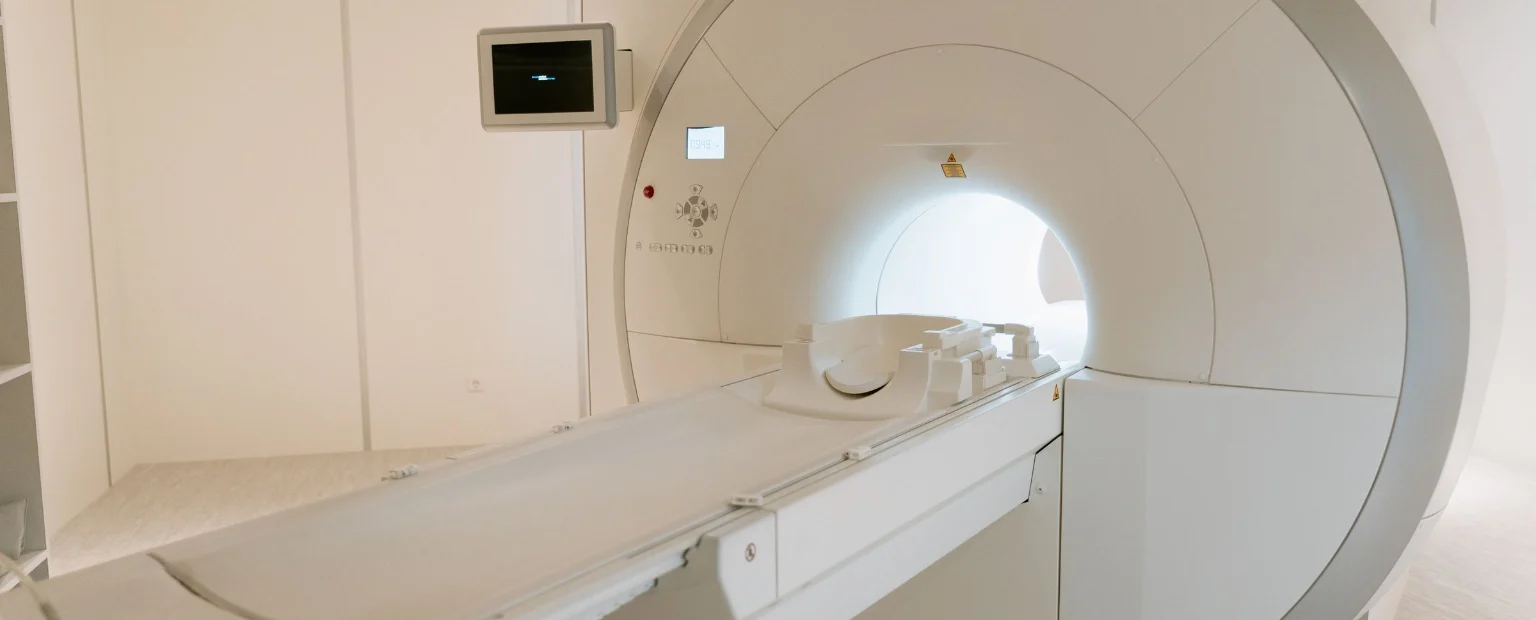
We supply MRI systems and take on the part that makes them difficult: the magnetic site survey, the RF cage, the quench route, the cooling and the structure. An MRI is a building project with a machine inside it.
What to settle before anyone quotes you a price
| Point | Why it matters | What we confirm in writing |
|---|---|---|
| Field strength | 1.5 T and 3 T are different clinical and different site problems | Field strength, and the fringe field map that comes with it |
| Bore diameter | Patient access, bariatric and claustrophobic cases | Actual bore, and the table weight limit |
| Gradient performance | Decides sequence speed and what advanced imaging is possible | Gradient amplitude and slew rate, per axis |
| Coils | Coils are most of the clinical capability and most of the hidden cost | The coil list supplied, and the price of the ones that are not |
| Helium | A refill is an expensive surprise | Whether the magnet is zero boil-off or sealed, and who pays for cryogens |
| Software licences | Sequences and post-processing are licensed separately | The licence list, perpetual or term |
| Conformity | Legal operation and safety | IEC 60601-2-33, the declaration of conformity, and local registration |
The site, which is the real project
- Magnetic survey. What moves near the magnet, what is affected by the fringe field, and where the 0.5 mT line falls — including on the floors above and below.
- RF cage. A Faraday enclosure built and tested for shielding effectiveness, with every penetration treated.
- Quench pipe. A route to open air sized and supported so a quench vents outside the building, not into the examination room.
- Structure and access. Several tonnes of magnet, delivered through an opening that often has to be created and then closed again.
- Cooling and power. Chiller and technical room sized to the manufacturer’s figures, with continuity of supply for the cold head.
- Safety zoning. The four-zone layout, controlled access, ferromagnetic screening and the signage that goes with it.
How the project runs
Survey
Magnetic and structural survey, access route, services, and a written report of what the site needs.
Specify and quote
System and coil configuration against your case mix, with the site works priced line by line.
Build and install
Cage, quench route, structure, power and cooling, then magnet delivery, rigging, ramping and installation.
Commission and hand over
Shielding effectiveness test, acceptance testing, PACS connection, safety training and the documentation file.
Common questions
1.5 T or 3 T?
It depends on what you will actually scan, not on the number. 3 T gives signal for neuro and musculoskeletal detail but brings more artefact and more siting constraint. We go through your expected case mix before recommending, and we will say so if 1.5 T is the better buy.
Can an MRI go into an existing building?
Often yes, and the survey tells you at what cost. The three things that kill a location are floor capacity, the quench route and a fringe field that reaches somewhere it must not. All three are checked before you commit.
Do you handle the site works, or only the machine?
Either. We can supply the system complete with the site works, or prepare the site for a system bought elsewhere.
Send us the room and the requirement
A room drawing, the throughput you need and the budget range. We come back with a configuration, a lead time and the site works that go with it.